Baby Monotonous
Big BrotherBaby Monotonous is the custom pull-string doll company Pandora Halfdanarson built from a family joke into a thriving manufacturer. Its dolls turn affectionate ridicule into a marketable product, but the company’s eventual decline also gives Pandora a reason to reconsider the value of professional success and the tone of the business she created.
Origins and Product
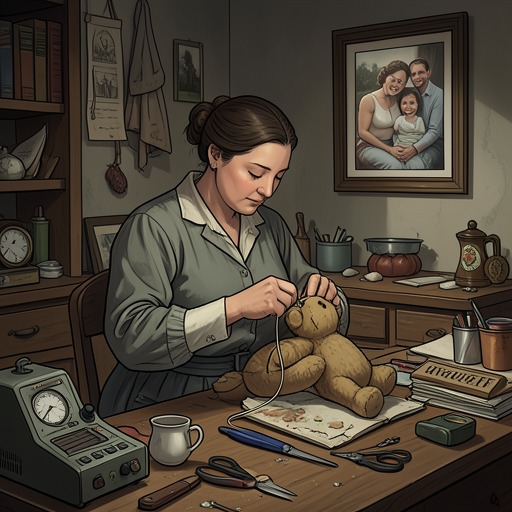
Baby Monotonous began with a handmade gag gift. After Fletcher Feuerbach adopted a health-conscious diet and stopped eating Pandora’s manicotti, Pandora sewed a pull-string doll as a way to keep her humor about the change. Their thirteen-year-old daughter, Cody, later tugged the doll’s string to tease Fletcher. Its recorded voice belonged to Pandora’s friend Oliver Allbless, who supplied a deliberately huffy, judgmental delivery; an electronic device in the doll’s torso held twenty edicts and exclamations. Pandora did not expect the handicraft to become a business.
The original joke established the product’s defining mix of ridicule and affection. The dolls were customized caricatures of their subjects, whom the company called “vics.” At first, customers supplied recordings of the subjects’ own voices. That process proved awkward: people found it difficult to capture usable recordings, and secretly recording a spouse felt uncomfortable. The company instead hired actors, with Pandora choosing voices to fit the scripts. Changing the voice, she explained, could make the satire more successful while softening the teasing. Casting became part of her work alongside running the business.
Growth and Manufacturing
Internet word of mouth carried the idea beyond its local origins. By the end of the year in which it caught on, Pandora had folded her earlier Breadbasket business, and Baby Monotonous had established headquarters outside New Holland with a full-time workforce. Fletcher’s teasing misnomer led some locals to think the company was actually called Baby Moronic. The dolls were expensive to make and more expensive to buy: a doll cost about as much as a KitchenAid mixer and a top-of-the-line Dyson, and its premium price helped make it a status item.
A tour of the headquarters shows the distance between the first homemade doll and the scaled-up operation. The factory’s open production area contained two dozen sewing machines, fabric stacked along the walls, and bags of cotton stuffing. Workers made custom orders from a limited set of standardized components: three body types—thin, average, and portly—in both sexes, and three fabric colors. The company also produced denim and leather jackets, then added personal details such as embroidery or political buttons. Standardized bodies made production more manageable, while customization preserved the individualized joke customers were buying.
The company’s success brought public visibility as well as work. Pandora’s stepchildren commissioned a doll modeled on her, choosing a mid-range build rather than the skinny version; at the company, that size was intended for subjects considered distinctly chubby. The doll had short, unruly yellow yarn hair, an expression of optimistic goodwill, and a Baby Monotonous sweatshirt bearing the company logo. Its recorded lines made the family laugh when they pulled its string. The product turned the company’s own founder into one of its subjects, folding family teasing back into the business’s public identity.
Pandora, Edison, and the Work of the Company
Baby Monotonous also became part of Pandora’s relationship with her brother, Edison Appaloosa. When he visited the headquarters, he was struck by the scale of the operation. Pandora introduced him to the receptionist and showed him the sewing floor and the company’s methods. Yet Edison had not recognized the business’s significance when Pandora had previously described it over the phone as Baby Moronic. He thought the venture sounded implausible and did not connect it to the dolls after a musician told him he had bought one for his wife’s birthday. By the time he understood that his sister’s company could have helped him, he had already sold his Schimmel piano; the money from his catering bag was barely in the black.
After Edison came to live with Pandora, the company offered him a practical role and a daily structure. Although he resisted working for his sister, he eventually tried the job and was relieved to get out of the apartment. He learned to sew and made miniature denim jackets. Pandora also used his booming voice for recordings of blustery characters, drawing on his sound as a casting resource. His coworkers came to like him, and his regular work gave his days a purpose beyond the weight-loss regimen he shared with Pandora. He was paid by the company, which reduced his need to ask her for spending money; he later campaigned to become its general manager.
The company’s work also made a contrast visible between the siblings’ ideas about achievement. Pandora had once found Baby Monotonous exciting, and its success gave her financial room to support Fletcher’s furniture-making and to establish a private rehabilitation clinic. But she came to doubt that professional achievement was a reason for living. Edison, meanwhile, had once assumed that early success meant he was exceptional and that opportunity would continue to arrive without sustained effort. Pandora believed he might benefit from work whose value lay in the labor itself, rather than in applause or recognition. At Baby Monotonous, he could contribute through sewing, recording, and routine participation in a workplace.
Market Decline and Closure
The same success that made Baby Monotonous a status product did not guarantee lasting demand. Pandora anticipated that the dolls might become old-fashioned and felt that their popularity could fade; when orders eventually dried up, it was unclear whether the cause was the product’s becoming passé or a sharp economic downturn. By then, Pandora had also grown uneasy with the joke at the company’s center. The dolls could express a mean streak she no longer wanted to endorse, even when customers enjoyed the teasing.
Pandora closed the company rather than risk her family’s savings. She let the employees go, sold the sewing machines, and shut the warehouse for good. She was sorry to lose the workers, but described feeling lighter and cleaner after ending the business. The closure was therefore both an economic decision and a change in her judgment of the product: the joke that had once launched the company had worn thin, and continuing to sell it no longer seemed worth the financial or personal cost.
Narrative Significance
Baby Monotonous links the book’s treatment of work, recognition, and appetite. Its rapid growth shows how a personal joke can become a standardized product without losing its promise of individual attention: the basic doll bodies are mass-produced, while voice, clothing, and distinguishing details make each one specific. The premium price converts that specificity into status. But the company’s rise also exposes the instability of success. Orders can vanish, a fashionable object can become unwanted, and a business that once seemed an answer to professional ambition can cease to matter to its founder.
The dolls’ satirical premise also echoes the novel’s concern with appetite and the search for satisfaction. In the book’s closing reflection, Pandora connects the company to the boredom of affluence and to Edison’s belief that he had been denied the worldly attention he deserved. The business had once offered Pandora a successful joke and a source of recognition; its eventual closure makes room for a more skeptical view of both achievement and plenty. The story’s final formulation, that people are meant to be hungry, gives the company’s arc a wider resonance: neither commercial success nor the satisfaction of having more than enough can promise lasting fulfillment.